Gender Mystery: Unlocking Masculine & Feminine in French
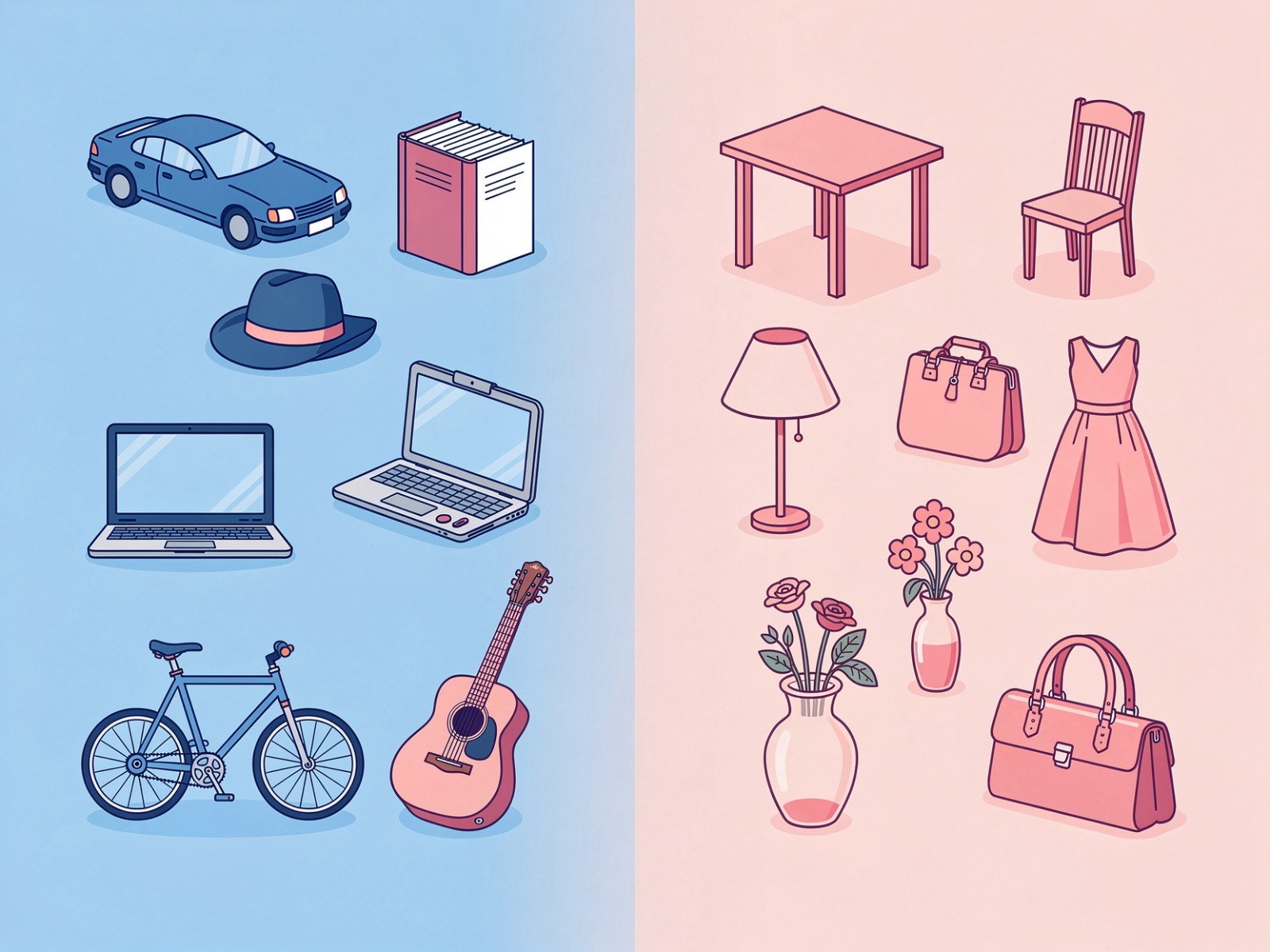
Let’s face it — French is a beautiful language… until you meet gendered nouns.
Suddenly, tables are feminine (la table), books are masculine (le livre), and you’re wondering, why is water (l’eau) feminine but wine (le vin) masculine?
It’s okay! We all have been there. But…
Fear not! You’re about to unlock the secrets of French gender with memory hacks, patterns, exceptions, and even some wordplay!
What Is Gender in French?
In French, every noun is either masculine or feminine— (it’s just grammar!). Just like some Indian and African languages, it is the same concept. To identify which is which, there’s a prefix attached to the noun. There are 2 prefixes:
- 🟦 Masculine: le stylo (the pen), un arbre (a tree)
- 🟥 Feminine: la chaise (the chair), une voiture (a car)
Rule #1: Always learn nouns with their article (le, la, un, une) — not just the word alone.
How to identify the masculine and feminine?
🡪 Look at the word endings — They Give Clues!
The endings of the words in French often hint at their gender. Here’s your cheat sheet:
Usually Masculine Endings:
- -age → le garage, le fromage
- -ment → le moment, le bâtiment
- -eau → le bateau, le cadeau
- -isme → le tourisme, le capitalisme
- -oir → le miroir, le tiroir
Usually Feminine Endings:
- -tion / -sion → la nation, la décision
- -té → la liberté, la beauté
- -ette → la baguette, la bicyclette
- -ure → la voiture, la confiture
- -ée → l’idée, l’arrivée
Do you notice that it is written “Usually” feminine/masculine endings. This is because there are some exceptions that we need to be careful about.
The Exceptions
French love exceptions — just to keep things interesting.
- Masculine words with feminine endings:
le musée (ends in -ée), le silence (ends in -ence), le lycée - Feminine words with masculine endings:
la plage, la cage, la nage (ends in -age), la peau (ends in -eau)
Here’s a surprise for you. To easily understand all the rules, watch our Masterclass on YouTube by clicking on this link:
https://www.youtube.com/watch?v=GXJlMmZieTY&list=PLdcRfRayZ_rmbkJYQjY6Ouu6R6WP6I0fv&index=3&t=3247s
Words of Fixed gender
Certain things in French have a fixed gender:
- Always Masculine:
- Days: le lundi, le dimanche
- Months: le janvier, le juillet
- Seasons: le printemps, l’hiver
- Languages: le français, le japonais
- Trees: le chêne, le sapin
- Always Feminine:
- Continents: l’Afrique, l’Asie
- Academic subjects: la chimie, la philosophie
- Fruits/veggies ending in -e: la banane, la pomme
Biological Gender
Just like in English, we have boy-girl, king-queen, etc… In French, the nouns have genders when it comes to people and animals:
- un garçon, une fille
- un coq, une poule
- un roi (king), une reine (queen)
Same Word, Different Meaning
Till now, everything was going smoothly. There were some rules to follow (with some exceptions) to identify masculine or feminine. But here’s where things get twisted. Some French words exist in both genders — but with totally different meanings!
Masculine | Meaning | Feminine | Meaning |
|---|---|---|---|
Un livre | A book | Une livre | A pound (weight/money) |
Un tour | A trip, turn | Une tour | A tower |
Un poste | A job | La poste | The post office |
Un mémoire | A thesis | Une mémoire | Memory |
Un critique | A critic | Une critique | A review |
Professions
French job titles have evolved over time. Some are neutral, some are gender-specific, and some… exist only in one form.
- Neutral: un/une journaliste, ministre, interprète
- Masculine used for all: un médecin (doctor), un ingénieur (engineer)
- New feminine forms (optional): un auteur – une auteure, un écrivain – une écrivaine
Be careful! Some feminine forms change the meaning:
un jardinier (gardener) ≠ une jardinière (window box!)
Final Tip: Don’t Memorize. Internalize!
French gender might seem frustrating at first — but treat it like a puzzle, not a problem. With time, patterns will stick, and the exceptions will feel natural.
But wait, we have another surprise for you!
Here’s the link of Part 2 of our Masterclass to help you fully master the topic:
https://www.youtube.com/watch?v=-Ot9SKWAQdM&list=PLdcRfRayZ_rmbkJYQjY6Ouu6R6WP6I0fv&index=2&t=1237s